Week starting 17th August: Good availability with most voices this week Studios reopen 9am Thursday 20th August Need help choosing a voice? Send us your brief
Get a quote

Fair Use Of AI: Results (updated May 2024)

Updated

Intro

Thanks to all voices who have given their input into this process.
If you haven't yet, it's not too late to get involved. Opinions and views are changing all the time, and we're looking to make this an ongoing process where feasible.

If you've not read why and how we're doing this, please check out the other pages in this section, such as:
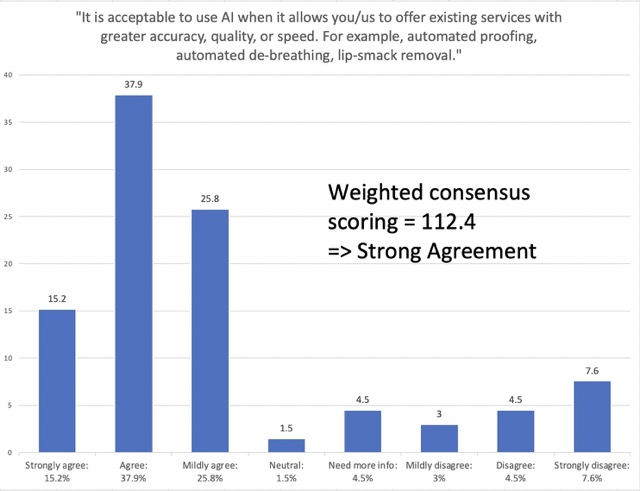
Statement 1: "It is acceptable to use AI when it allows you/us to offer existing services with greater accuracy, quality, or speed.
Statement 1: "It is acceptable to use AI when it allows you/us to offer existing services with greater accuracy, quality, or speed. For example, automated proofing, automated de-breathing, lip-smack removal." There is strong agreement in the voiceover community to make use of AI in this context. But only when it is safe to do so, such as when you are not giving away useful training data which could be used against the industry in the future.
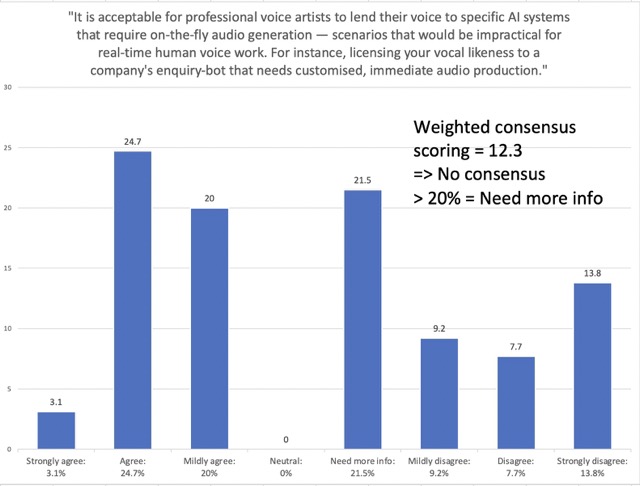
Statement 2: "It is acceptable for professional voice artists to lend their voice to specific AI systems that require on-the-fly audio generation
Statement 2: "It is acceptable for professional voice artists to lend their voice to specific AI systems that require on-the-fly audio generation — scenarios that would be impractical for real-time human voice work. For instance, licensing your vocal likeness to a company's enquiry-bot that needs customised, immediate audio production." This statement did not come to a consensus - and there is quite a varied point of view in the community - as well as a high level of voices saying they need more info. We encourage those voices who voted Strongly Disagree and Disagree to let us know their main concerns so we can open up the discussion.
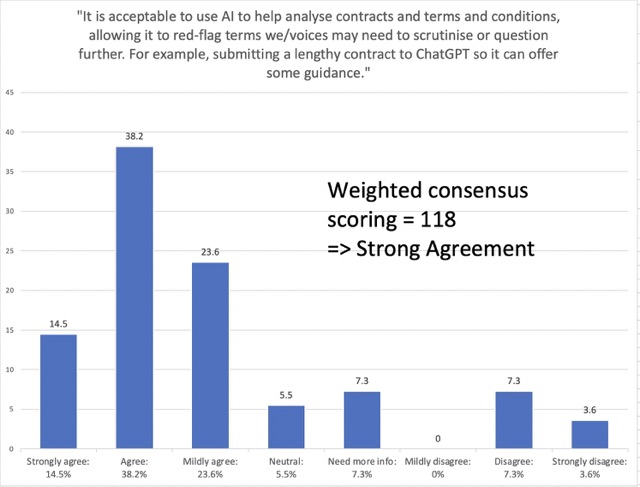
Statement 3:
Statement 3: "It is acceptable to use AI to help analyse contracts and terms and conditions, allowing it to red-flag terms we/voices may need to scrutinise or question further. For example, submitting a lengthy contract to ChatGPT so it can offer some guidance." There is strong agreement in the voiceover community to make use of AI in this context. We've made a video to assist those voices who need more information about how to do this.
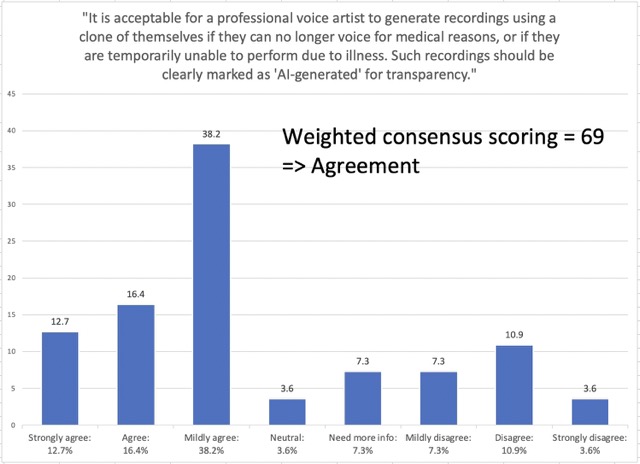
Statement 4:
Statement 4: "It is acceptable for a professional voice artist to generate recordings using a clone of themselves if they can no longer voice for medical reasons, or if they are temporarily unable to perform due to illness. Such recordings should be clearly marked as 'AI-generated' for transparency." There is agreement in the voiceover community to make use of AI in this context. Although some voices still have their concerns. We would advise voices to be very cautious of having their voice cloned at the current time - although quick cloning may be okay to do. See the 'Should I clone my voice' page in this section.
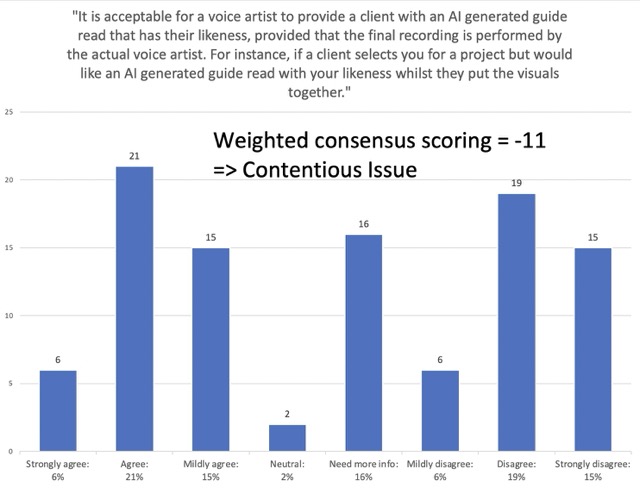
Statement 5:
Statement 5: "It is acceptable for a voice artist to provide a client with an AI generated guide read that has their likeness, provided that the final recording is performed by the actual voice artist. For instance, if a client selects you for a project but would like an AI generated guide read with your likeness whilst they put the visuals together." This was another contentious issue. A slight majority agreed with the statement, but taking into consideration the strength of the sentiments gives a slight disagreement. However no clear consensus was obtained.
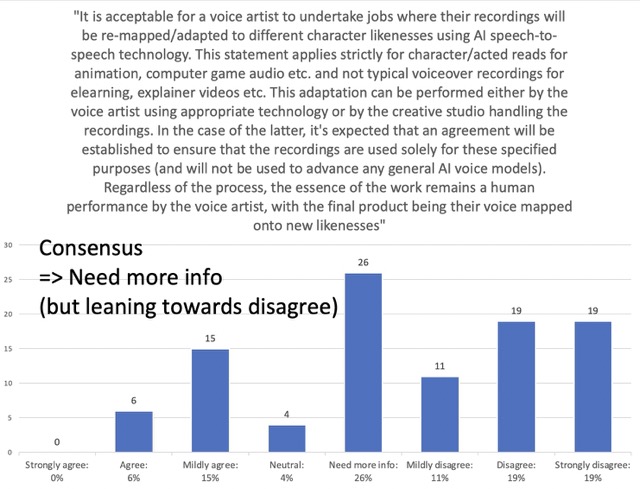
Statement 6:
Statement 6: "It is acceptable for a voice artist to undertake jobs where their recordings will be re-mapped/adapted to different character likenesses using AI speech-to-speech technology. This statement applies strictly for character/acted reads for animation, computer game audio etc. and not typical voiceover recordings for elearning, explainer videos etc. This adaptation can be performed either by the voice artist using appropriate technology or by the creative studio handling the recordings. In the case of the latter, it's expected that an agreement will be established to ensure that the recordings are used solely for these specified purposes (and will not be used to advance any general AI voice models). Regardless of the process, the essence of the work remains a human performance by the voice artist, with the final product being their voice mapped onto new likenesses." Although there is currently an overall disagreement, over 25% of respondents said they need more information before deciding.