Week starting 17th August: Good availability with most voices this week Studios reopen 9am Thursday 20th August Need help choosing a voice? Send us your brief
Get a quote

State of the Industry Report 2024

Updated

Introduction

[Survey carried out December 2024. Results published January 2025]

The 2024 Voiceover Industry Survey captures the evolving sentiments, challenges, and opportunities within the voiceover community. This year, the results highlight both the resilience of professionals and the shifting dynamics of the industry, driven by economic pressures and the growing influence of AI.

While concerns about revenue declines and industry contraction are prevalent, many respondents continue to see voiceover as a vital part of their careers. A majority remain committed to their craft, identifying it as their primary income source, either alone or alongside other pursuits. The need for adaptation is a recurring theme, as artists explore diversification and advocate for legislative protections against unauthorised AI use.

Creative strengths, such as script interpretation and vocal timbre, continue to define the success of voiceover artists, emphasising the irreplaceable value of human artistry. Respondents also shared a wealth of ideas for navigating challenges, including advocating for stronger industry standards, promoting the environmental and ethical benefits of human voiceovers, and fostering deeper connections with clients.

This survey not only reflects the challenges faced by voiceover artists but also highlights their resourcefulness and commitment to preserving the unique qualities of their profession. It serves as both a snapshot of the current landscape and a call to action for collective growth and innovation.
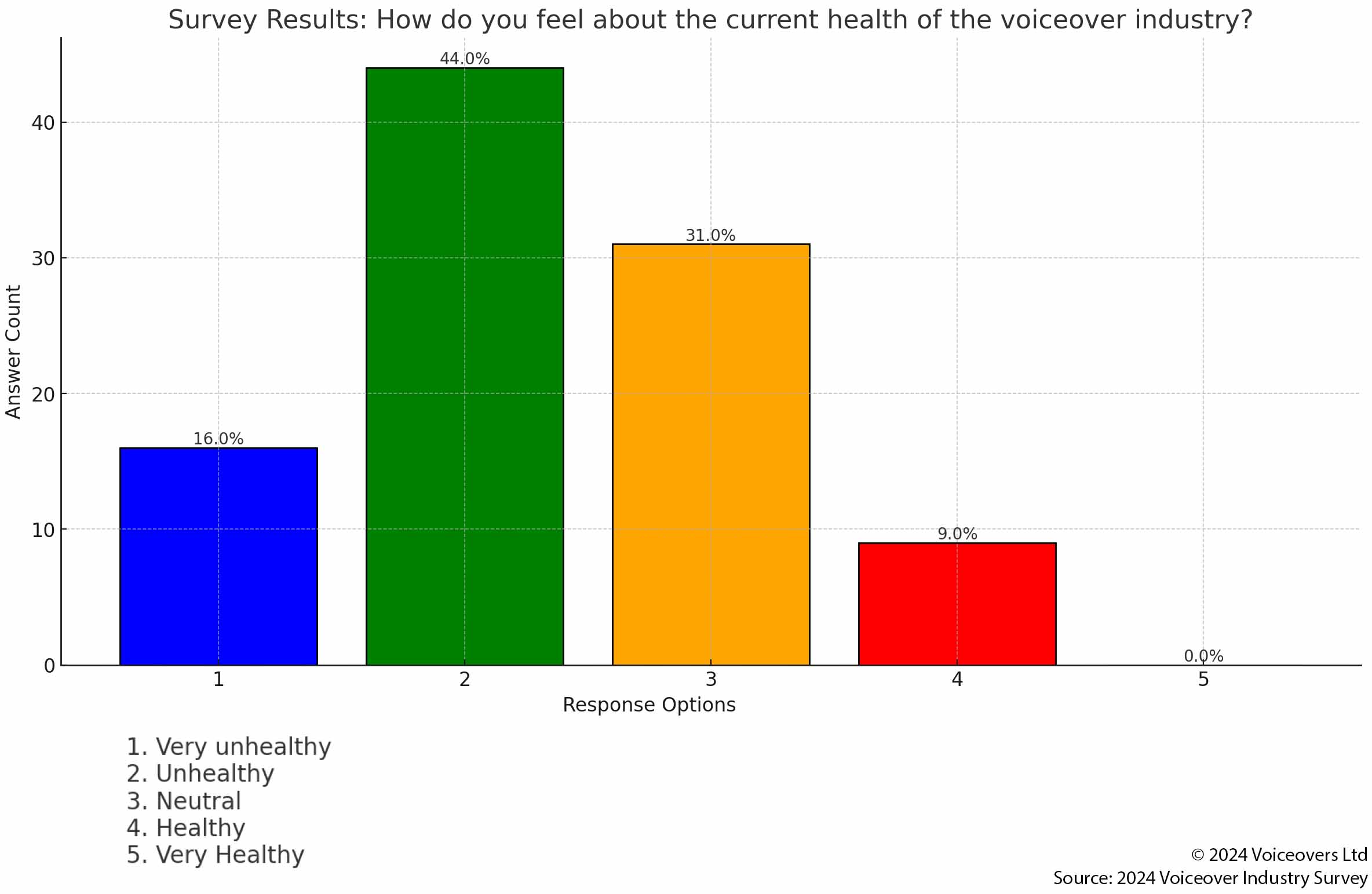
Question: "How do you feel about the current health of the voiceover industry?" • 60% feel the industry is “Unhealthy” or “Very Unhealthy.
Question: "How do you feel about the current health of the voiceover industry?" • 60% feel the industry is “Unhealthy” or “Very Unhealthy.” • 31% are “Neutral,” and 9% consider it “Healthy.” Last year, 91% expressed moderate to extreme concern about the industry’s future. This year, while concerns remain high, a notable portion is feeling more neutral or even optimistic. While challenges like AI persist, these results show resilience and adaptability within our community. Some voices are finding stability, and many are likely navigating changes with a focus on their unique skills and value. Emphasise what makes human voiceovers stand out... emotional nuance, storytelling, and flexibility. Together, we can adapt, thrive, and continue to set ourselves apart.
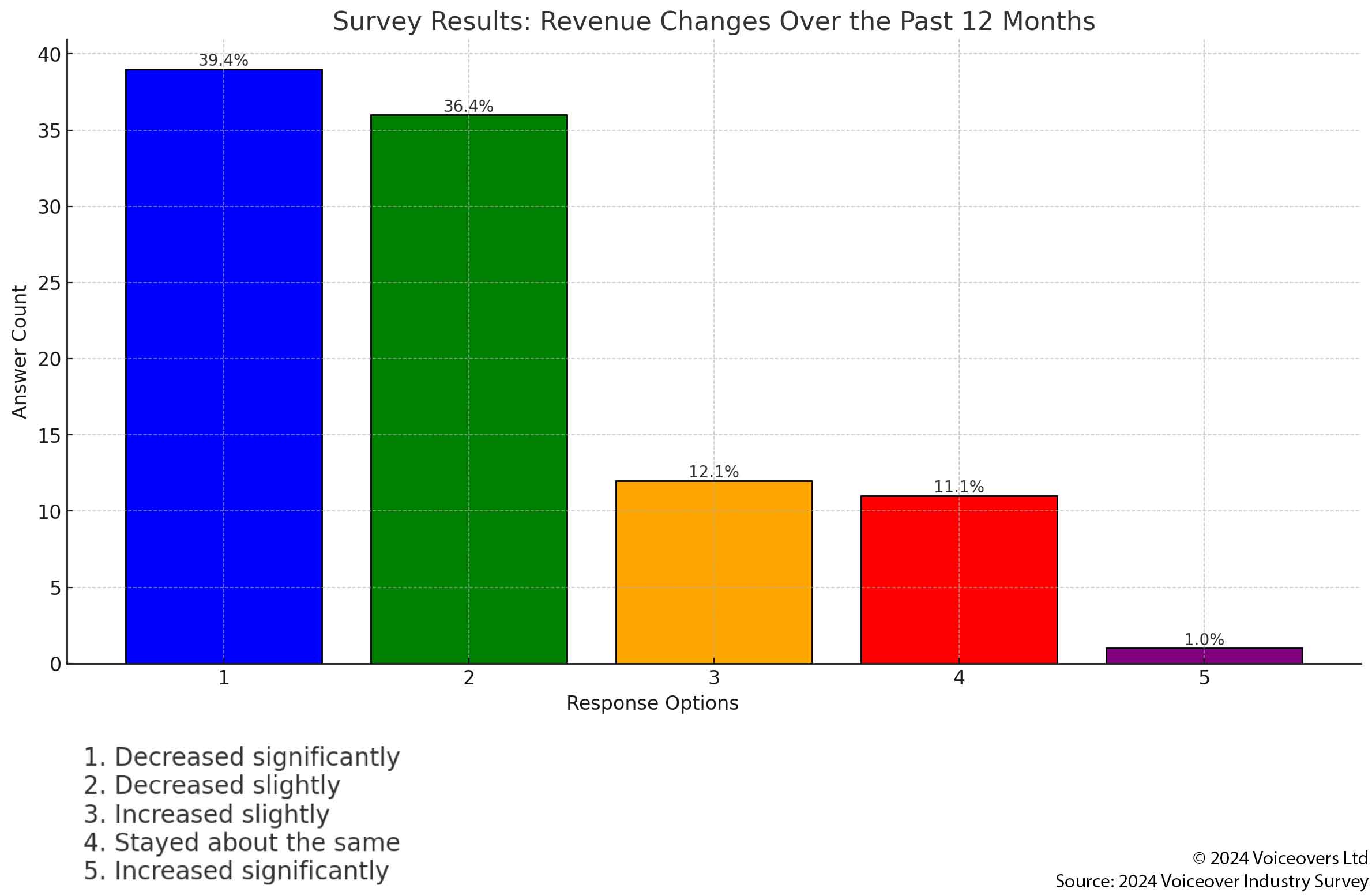
Question: "Over the past 12 months, would you say your revenue has..." • Decreased significantly: 39.4% • Decreased slightly: 36.4% • Increased slightly: 12.
Question: "Over the past 12 months, would you say your revenue has..." • Decreased significantly: 39.4% • Decreased slightly: 36.4% • Increased slightly: 12.1% • Stayed about the same: 11.1% • Increased significantly: 1.0% A striking 75.8% of respondents report some level of revenue decline, with a substantial 39.4% experiencing significant decreases. This highlights challenging market conditions that are affecting the majority of voiceover artists. However, 13.1% reported increased revenue, indicating that some professionals are finding opportunities to grow despite the difficulties. The results underscore the challenging economic environment for many in the voiceover industry. However, the presence of growth for some indicates that resilience and adaptability can lead to success even in tough conditions.
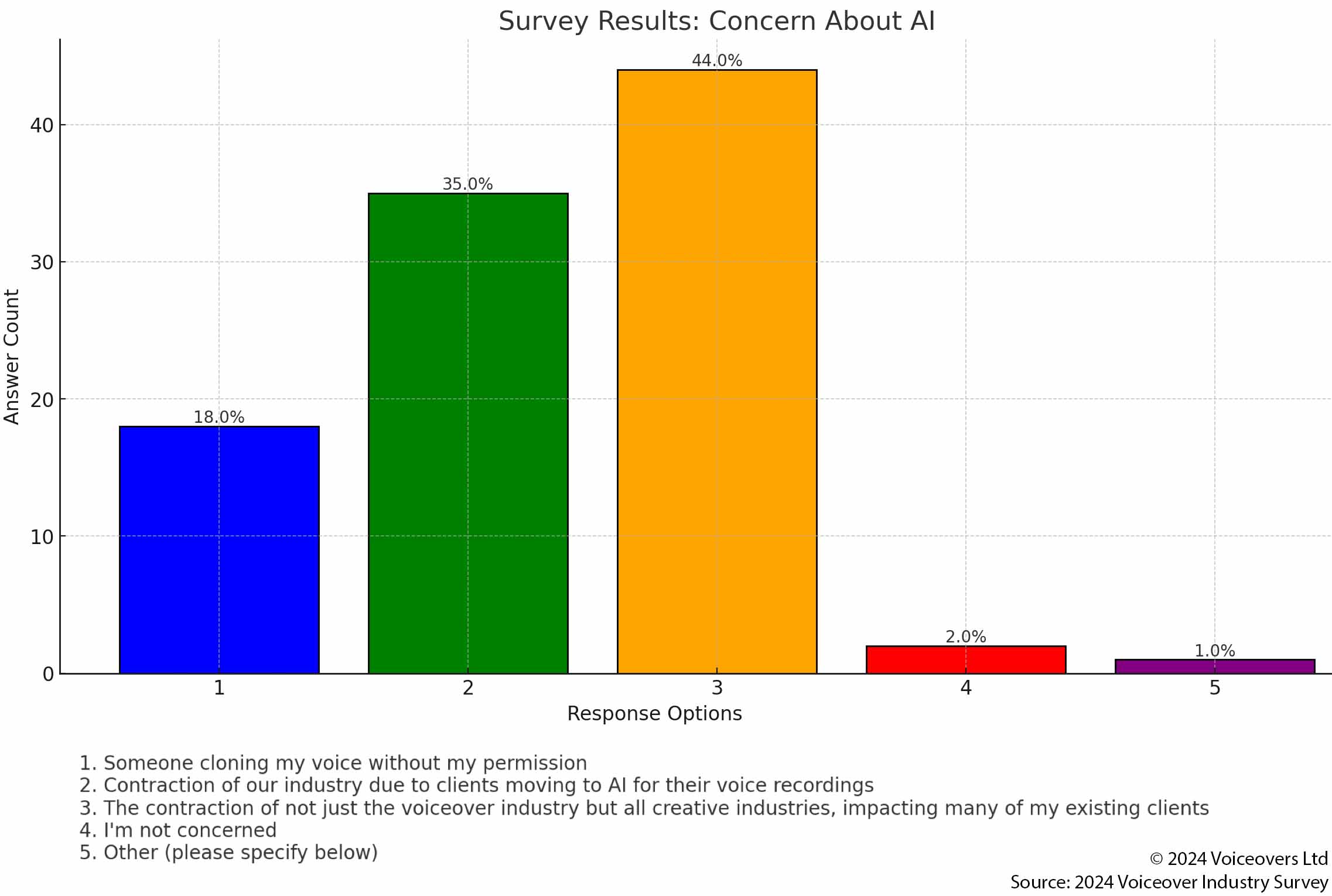
Question: "Are you concerned about AI? If yes, what concerns you the most?
Question: "Are you concerned about AI? If yes, what concerns you the most?" • Overall contraction of the creative industries: 44% • Clients moving to AI solutions: 35% • Voice cloning without permission: 18% • No concerns: 2% • Other: 1% The majority (79%) worry about economic shifts or AI’s impact on the creative fields, showing that broader industry trends dominate fears over specific technologies like cloning. The “Not concerned” group is very small but exists, showing some optimism. Emphasising collaboration and education about ethical AI use could help. Last year's concerns were similar.
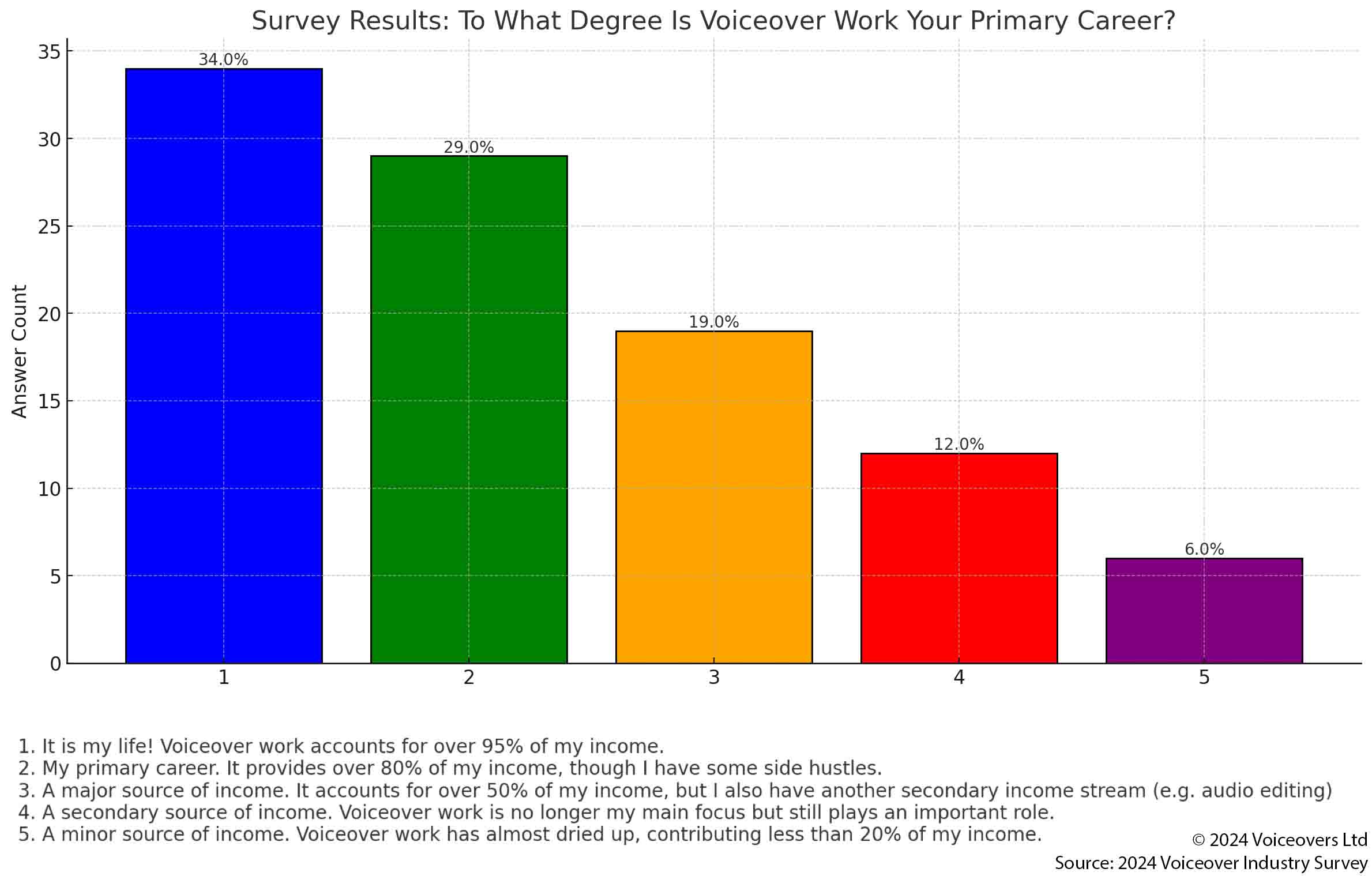
Question: "To what degree is voiceover work your primary career?
Question: "To what degree is voiceover work your primary career?" The question evaluates how significant voiceover work is as an income source: • Over 95% of income (life’s work): 34% • Primary career (over 80% of income): 29% • Major source (over 50% of income): 19% • Secondary source (under 50% of income): 12% • Minor source (occasional work): 6% In 2023, 85% of respondents said voiceover work was their primary income source, with 40% attributing over 95% of their income to it. The 2024 results show a slight reduction in these numbers. What This Means: Voiceover work remains central for most artists, with 82% reporting it as their primary or major income source. However, a shift toward diversified income streams may reflect ongoing adaptation to market changes. We recommend you exploring complementary skills and services while maintaining focus on your core voiceover work. Flexibility, creativity, and connection with clients can help maintain income levels and slow down industry shifts.
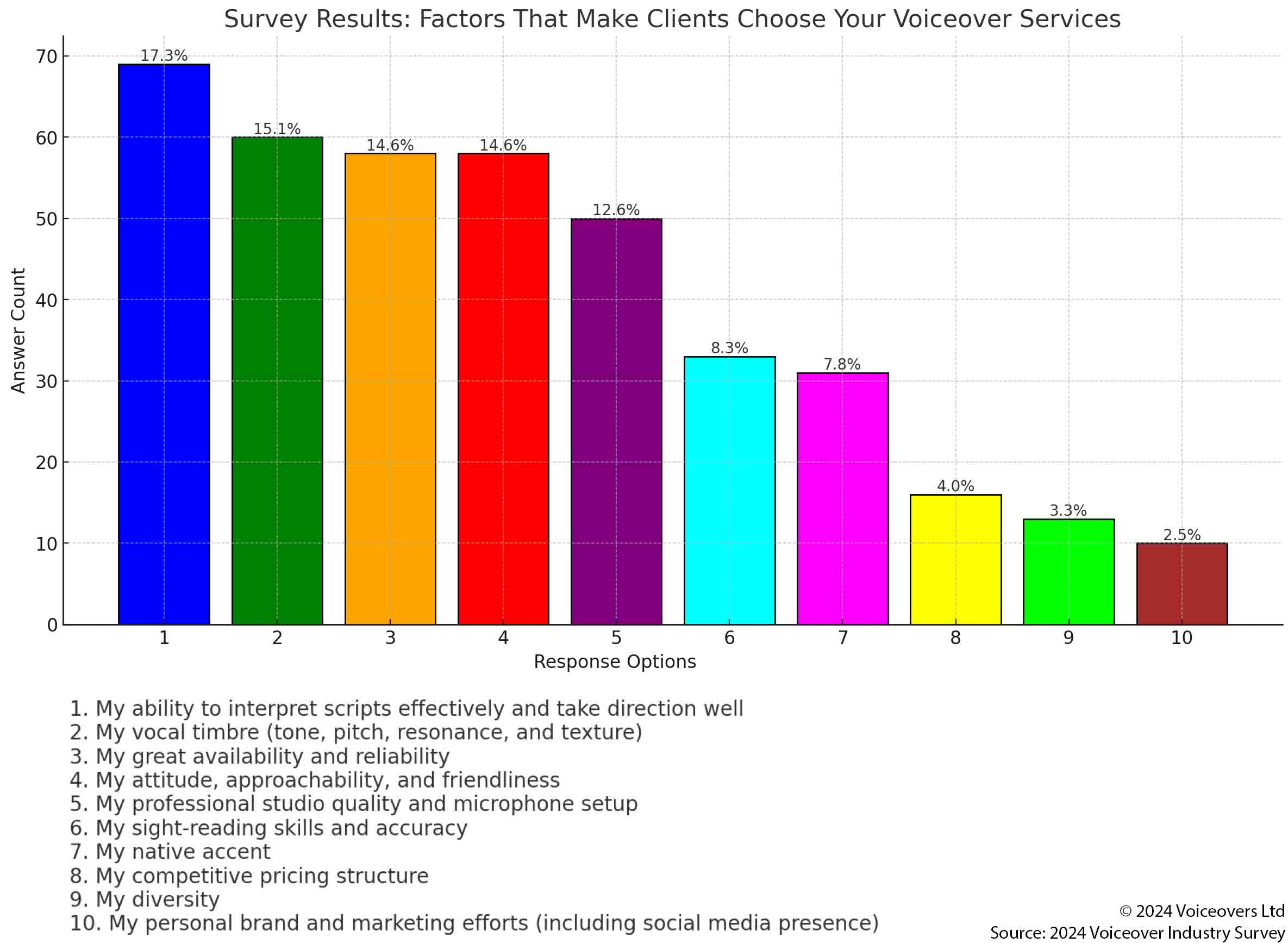
Question: "Referring to the list below, what factors do you think make clients choose your voiceover services over others?
Question: "Referring to the list below, what factors do you think make clients choose your voiceover services over others?" This question explored which attributes voiceover artists believe most contribute to their success (multiple choices allowed): • Script interpretation: 17.3% • Vocal timbre: 15.1% • Availability/reliability: 14.6% • Approachability/friendliness: 14.6% • Professional studio quality: 12.6% • Other attributes like pricing and personal branding received lower emphasis. In 2023, the ability to interpret scripts effectively and vocal timbre were also highlighted as top attributes.
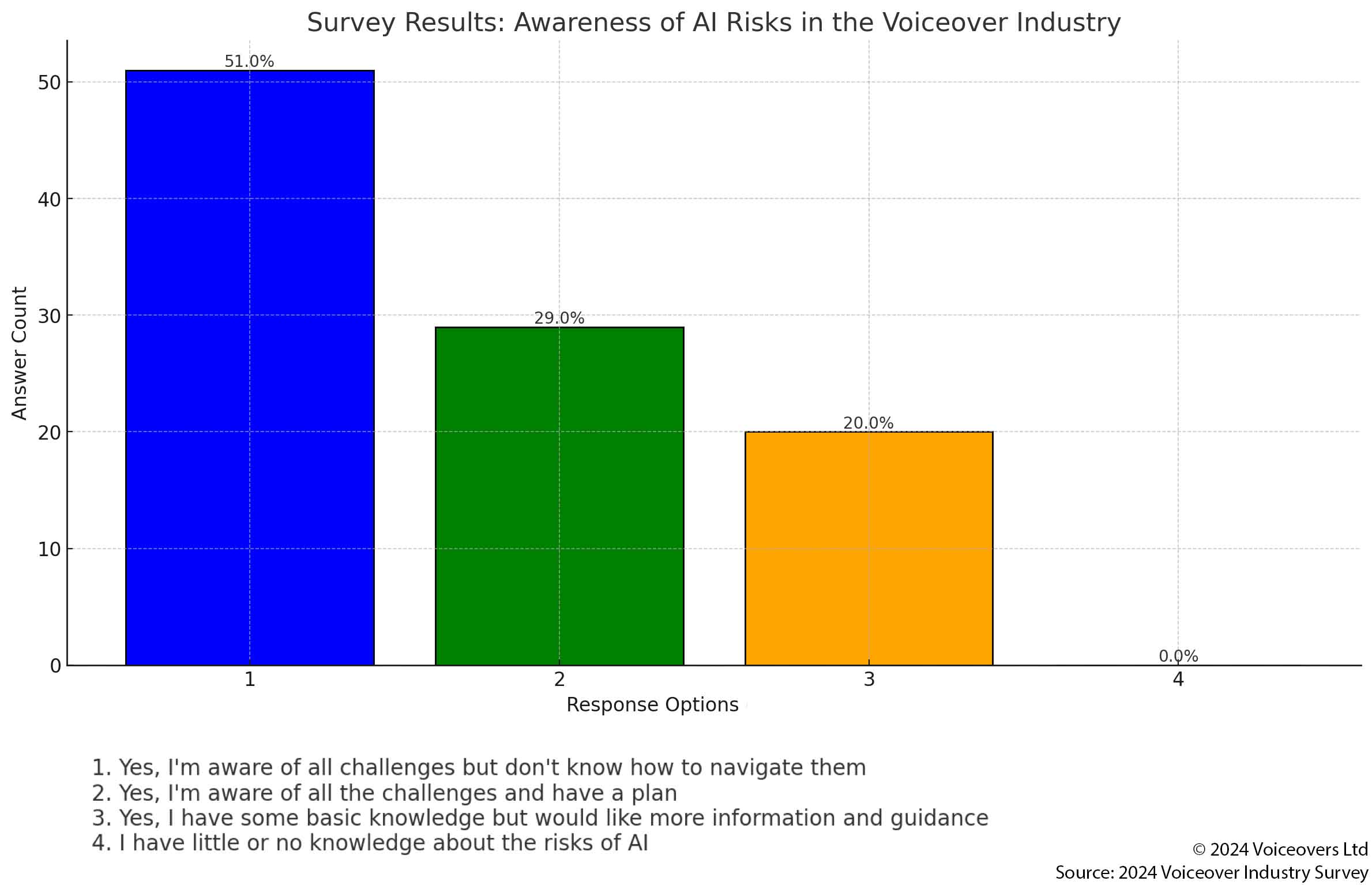
Question: "Are you aware of the issues and risks posed to the voiceover industry by AI?
Question: "Are you aware of the issues and risks posed to the voiceover industry by AI?" This question examines awareness and preparedness regarding AI and legislative challenges: • Aware but unsure how to respond: 51% • Aware and have a strategy: 29% • Some knowledge, need more guidance: 20% • Little to no knowledge: 0% In 2023, 18% of respondents had a clear plan regarding AI challenges, indicating an increase in preparedness this year. However, many still expressed a need for more information and strategies. While awareness is high, a majority feel uncertain or underprepared to address challenges like AI and legislative changes. This highlights the need for more resources, education, and community support to empower voiceover artists.
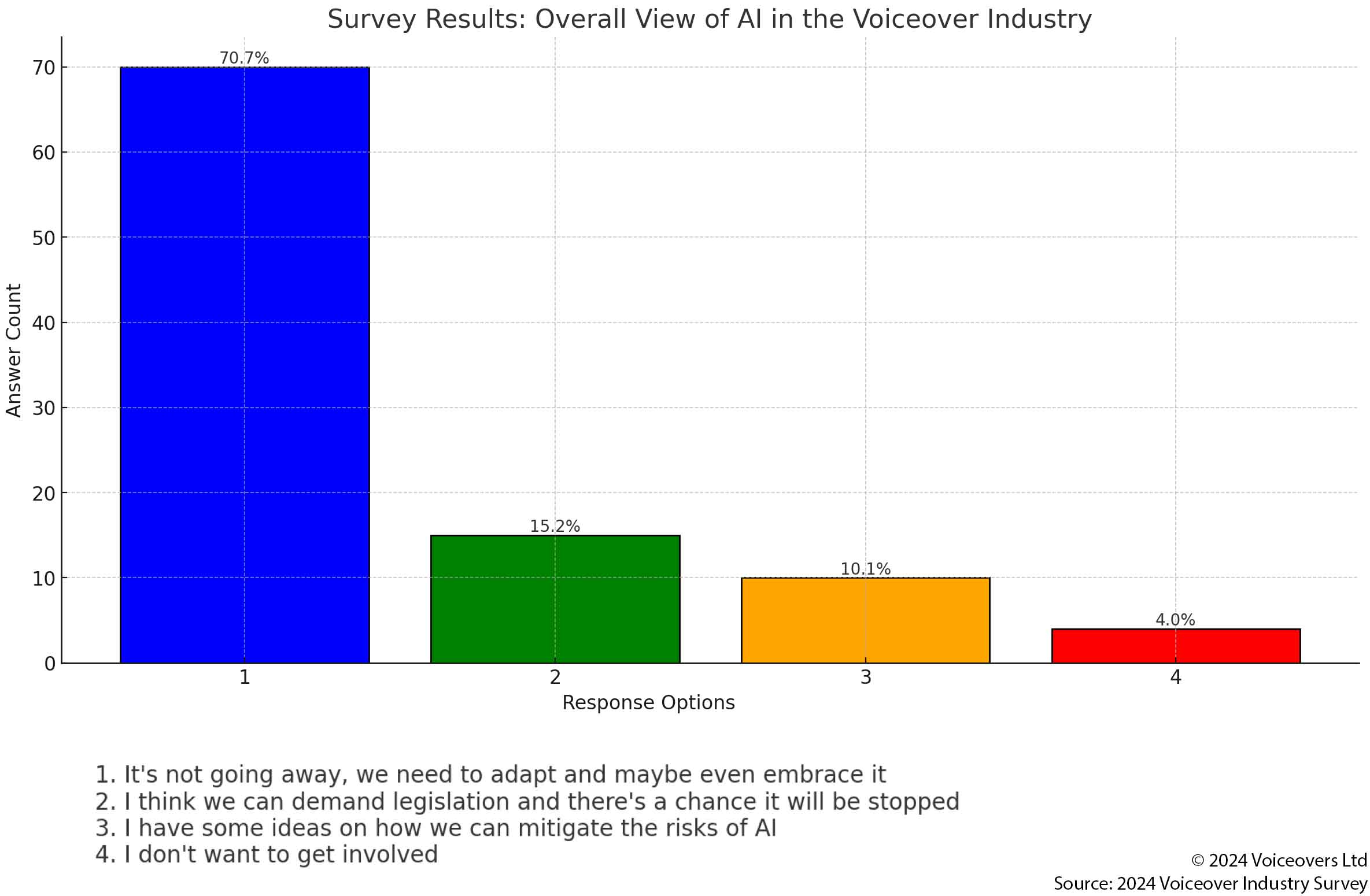
Question: "What is your overall view of AI as it affects the voiceover industry?
Question: "What is your overall view of AI as it affects the voiceover industry?" This question explores attitudes toward the future of voiceover work in the context of AI: • Adapt and coexist with AI: 70.7% • Demand legislation to curb AI: 15.2% • Propose mitigation ideas: 10.1% • Avoid involvement: 4.0% Last year, there was growing recognition of the need to adapt to AI, with many advocating for legislative protection and collaboration. The 2024 results emphasise an even stronger push for adaptation. The majority of voiceover artists acknowledge AI’s permanence and emphasise the importance of adapting.
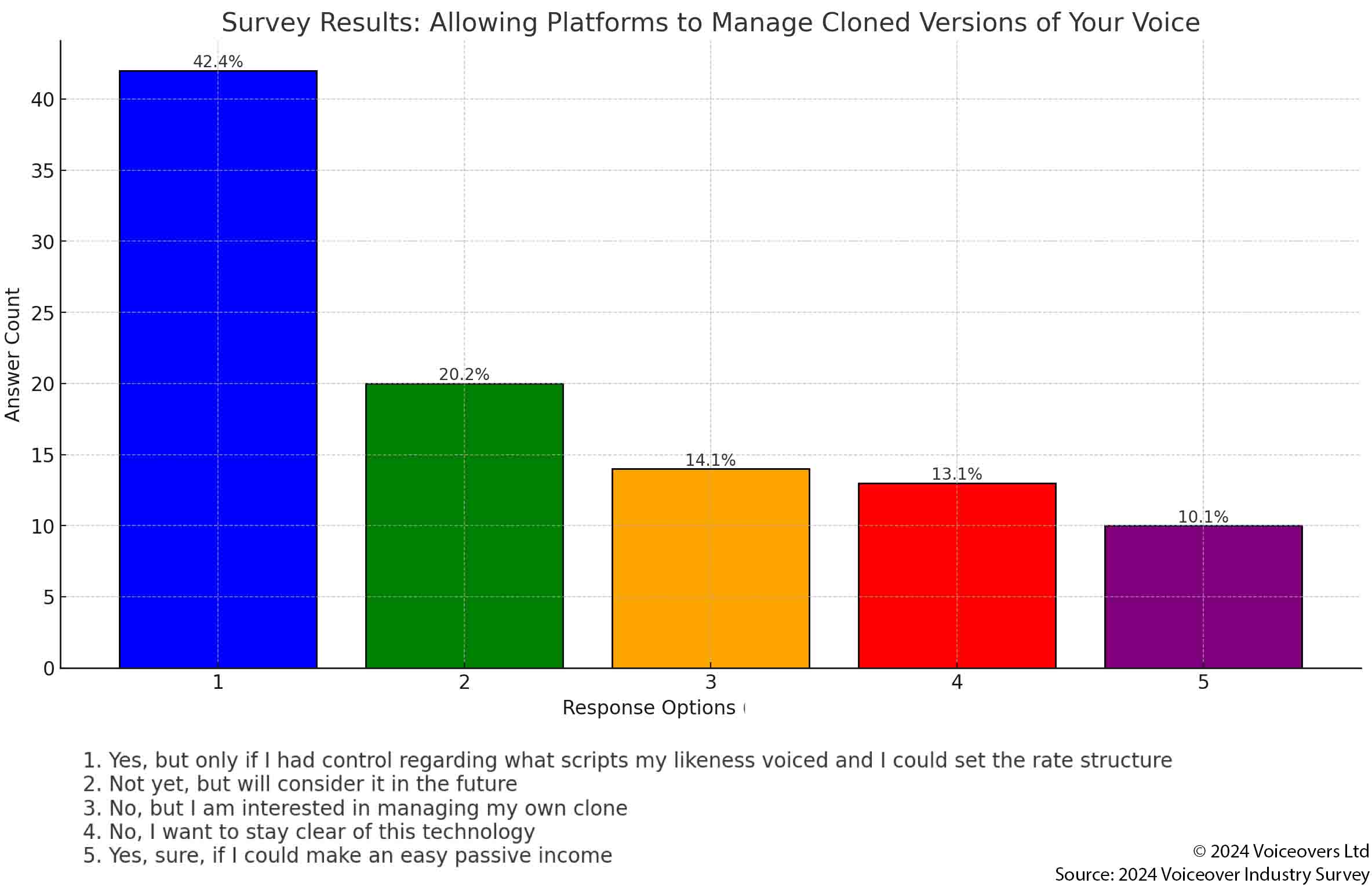
Question: "Would you allow a platform to manage a cloned version of your voice for voiceover work?
Question: "Would you allow a platform to manage a cloned version of your voice for voiceover work?" The question gauges interest in engaging with AI and voice cloning: • Willing with proper controls: 42.4% • Future consideration: 20.2% • Interested in managing their own clone: 14.1% • Open for passive income opportunities: 10.1% • Want to avoid the technology: 13.1% In 2023, 40% expressed openness to voice cloning with proper controls, while 21% were undecided and 20% wished to avoid it entirely. The 2024 results show continued interest in cautious adoption, with a slight increase in proactive considerations. A significant portion of voiceover artists are open to exploring AI technologies if they retain control over their usage. However, a notable group remains wary, highlighting the need for transparency and ethical practices.
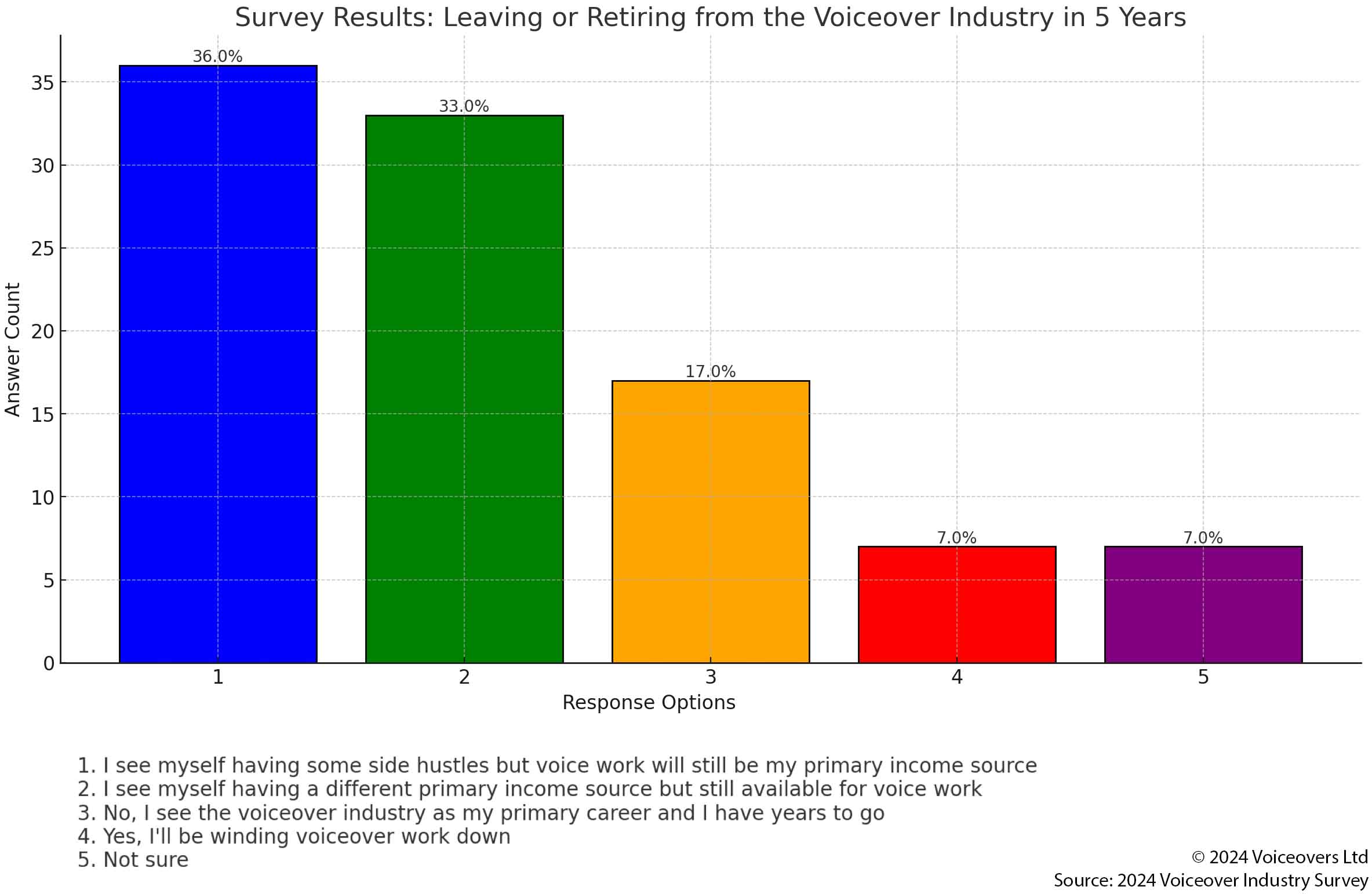
Question: "In the next 5 years, do you see yourself choosing to leave or retire from the voiceover industry?
Question: "In the next 5 years, do you see yourself choosing to leave or retire from the voiceover industry?" • Voiceover with side hustles: 36% • Voiceover as the sole income source: 17% • Shifting to a different primary income source: 33% • Winding down voiceover work: 7% • Uncertain about the future: 7% This year, 53% view voiceover will still be their primary income source (either solely or combined with side hustles), which is consistent with 2023’s 52%. The majority of voiceover artists remain committed to the profession, either as their main focus or as part of a diversified approach. While some explore alternative income sources, the core belief in voiceover work’s viability remains fairly strong.

Thank you

We’d like to extend a heartfelt thank you to all our voiceover subscribers for sharing your insights and experiences in this year’s survey. Your perspectives are invaluable in helping us understand the evolving landscape of our industry and the challenges and opportunities we face together.

Over the coming months, we’ll be diving deeper into these results, analysing them further, and using them to shape our approach. Whether it’s through updates in our Happy Friday emails, enhancements to our AI support pages, or new initiatives to support the community, your feedback will directly influence how we adapt and grow as a community.